AI-Powered Clinical Dashboards : Streamlining Workflow for Better Healthcare Insights

Today’s hospitals are overwhelmed by data. Each ECG, lab test, prescription, radiology scan, and nursing note accumulates a flood of data. However, the clinicians who require that information more frequently find it difficult to obtain it fast enough to make informed decisions. It should come as no surprise that almost every clinical team reports some degree of cognitive overload while making the decisions between EHR navigation, manual chart reviews, and frequent interruptions.
This gap between “data available” and “data usable” is exactly where AI-powered clinical dashboards are changing the game. These dashboards aren’t just prettier versions of traditional charts. They actively interpret data, surface what matters, and remove countless small friction points that slow down care teams.
In this blog, we’ll explore why these dashboards are becoming essential in modern hospitals, which workflows they transform, and how organizations can implement them without disrupting clinical operations.
AI Dashboard Adoption in Healthcare: Key 2025 vs Prior Years
The global AI in healthcare market increased from around $29.01 billion in 2024 to an estimated $39.25 billion in 2025, demonstrating substantial investment and commercialization of clinical AI tools (including dashboards and decision assistance).
Predictive analytics, a core feature of AI clinical dashboards, increased from about $1.806 million in 2017 to an anticipated $8.464 million by 2025, demonstrating the widespread use of forecasting tools among providers. This demonstrates how predictive models are being used more often in operational forecasts, deterioration detection, and triage.
Hospital adoption is inconsistent but accelerating: While smaller and rural hospitals typically stay below 50% of adoption, large urban and multi-hospital systems report substantially higher AI usage (often around 80–90% for at least one AI application). This gap indicates differences in the preparedness and ability to integrate AI-powered clinical dashboards.
Clinical success and real-world impact remain mixed: Survey data indicate that only about 19% of institutions reported a high degree of success for AI used in clinical diagnosis (imaging/diagnostic AI), underscoring that adoption does not always equal effective deployment — careful validation, governance, and workflow integration remain essential.
Why Today’s Clinical Workflows Need a Smarter Approach
Healthcare workflow problems are rarely rooted in a lack of information—there’s more than enough of it. The real challenge is how fragmented it is across EHRs, imaging systems, bedside devices, and handwritten notes.
Clinicians are expected to:
- Jump between 6–10 systems during a single patient encounter
- Reconstruct a patient story from disconnected pieces
- Interpret dozens of alerts and decide which ones matters
- Navigate staffing gaps and unpredictable patient volumes
- Maintain quality and compliance under rising pressure
It’s an environment where every second counts, but every second is contested. AI-powered dashboards step in as a unified, intelligent layer on top of these systems. They gather, clean, interpret, and display the right information at the right moment—reducing the cognitive burden on care teams.
AI-Powered Clinical Dashboards: Overview
Think of them as a hospital-wide command center, not just a graph on a screen. They combine:
- Real-time data integration from EHRs, LIS, PACS, RTLS systems, medical devices
- AI models that detect patterns, predict risks, and highlight anomalies
- Visualizations that simplify complex information in seconds
- Workflow automation that routes tasks to the right team member automatically
Unlike traditional dashboards—which only display data—AI dashboards interpret it. Here’s how AI clinical dashboards differ from static ones.
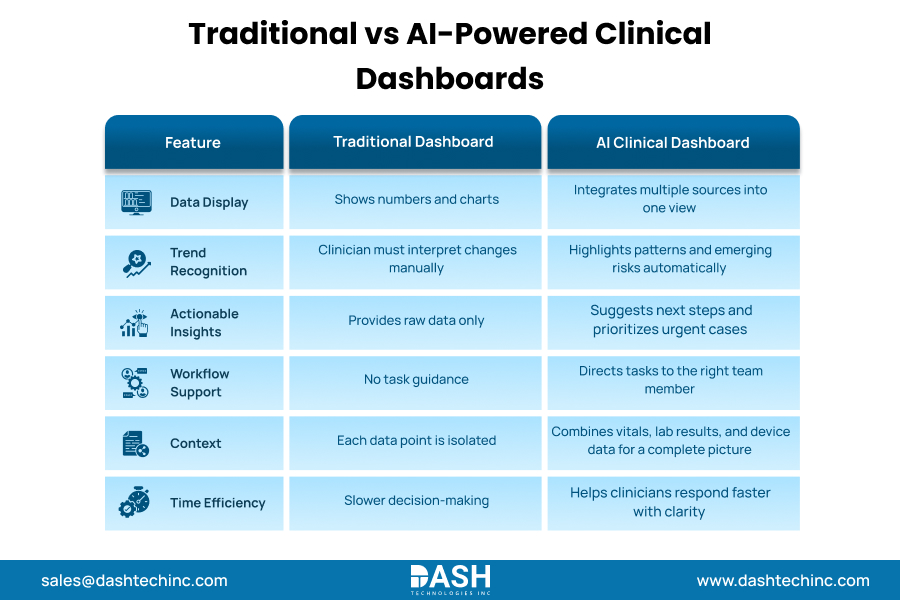
Which Clinical Challenges Do AI Dashboards Solve?
- Too many manual charts review
Clinicians spend a huge portion of their day digging through records. AI dashboards pull the most relevant data into a single snapshot. - Delays caused by poor visibility
If ED beds fill up suddenly or labs start getting delayed, downstream teams often find out too late. Dashboards monitor operational patterns and flag issues early. - Alert fatigue
Most alerts are generic. AI models prioritize alerts based on risk and the patient’s history, reducing noise for clinicians. - Slow decision-making in emergency scenarios
Whether it’s rapid triage or ICU crisis management, having real-time, context-rich insights improves decision-making dramatically. - Staff workload imbalance
AI can recommend how to distribute tasks based on acuity, staffing ratios, and current patient load.
These aren’t theoretical benefits—they directly impact efficiency and patient safety.


Comments
Post a Comment