Why Cardiology Departments Need Integrated Clinical and Financial Dashboards?

Running a modern heart program requires more than just excellent patient care; it demands rigorous clinical and financial data integration. Without integrated cardiology department performance dashboards, hospital leaders are forced to manage their service lines in complete silos. This makes it hard to see the cause and effect. Leaders might notice rising costs but miss the clinical reasons behind them. They may see better outcomes but lack insights into financial sustainability.
Cardiology is both clinically complex and financially intensive as well. Procedures such as PCI, electrophysiology, and structural heart cases use high-cost supplies. They require special staff. Good coordination is key to success. In many organizations, clinical metrics are in one system and financial data is in a different system. This separation can complicate overall analysis and decision-making. Healthcare dashboards that link these views help leaders make informed decisions. This balance improves quality, access, and profit margins.
For a broader look at how analytics transforms heart programs, explore our guide on The Role of Data Analytics in Modern Cardiology Care Delivery.
Why Cardiology Requires Both Clinical and Financial Visibility?
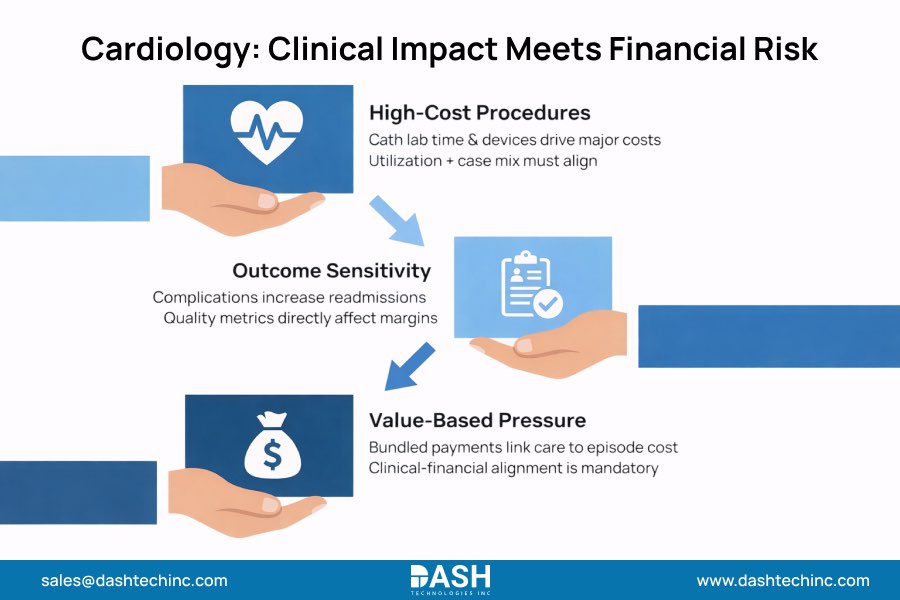
Few service lines carry the dual weight of clinical risk and financial consequence the way cardiology does. Cardiology service line management affects patient safety and financial results. Choices made here influence both areas at the same time.
- High-Cost Procedures and Resource Intensity: Cath lab time, stents, imaging, and post-op monitoring cause high supply costs and also drive-up labor costs. Leaders need to see utilization alongside case mix to optimize without compromising access.
- Outcome Sensitivity and Quality Metrics: PCI and TAVR procedures can have complications. These complications can lead to more readmissions. They also affect patient satisfaction and payer penalties. Clinical visibility must connect to financial impact.
- Growing Value-Based Care Pressures: Bundled payments and ACO contracts demand cardiology leaders understand the relationship between care decisions and total episode cost. Clinical financial alignment in healthcare isn’t optional; it’s a management requirement.
Decisions here aren’t “clinical OR financial”; they’re both, every time.
The Problem with Separate Clinical and Financial Reporting
For decades, the standard approach to fragmented healthcare reporting has been to let the Chief Medical Officer worry about the clinical outcomes, and the Chief Financial Officer worry about the margins. This creates massive cardiology reporting challenges that stifle meaningful growth.
When reports are separate, they are almost always lagging. A financial report detailing a massive loss in the Cath lab during Q1 usually lands on a director’s desk in mid-May. By that point, whatever operational bottleneck caused the loss has already been draining resources for another six weeks.
Furthermore, disconnected outcome data leads to counterproductive arguments. The clinical team may celebrate a shorter length of stay. But without financial data, they might miss that their discharge protocol is leading to more costly emergency visits a week later. You can’t connect care decisions to their real costs when the data is in different ZIP codes.
Many organizations attempt to improve outcomes without adding burden to face this exact disconnect, as discussed in How Cardiology Providers Can Improve Outcomes Without Increasing Clinical Burden.
What Integrated Dashboards Actually Do?
Integrated cardiology dashboards are centralized analytics systems that combine clinical, operational, and financial metrics into a single performance model. In healthcare analytics visualization terms, the goal is to make complex relationships easy to see what’s changing, where it’s changing, and what’s driving it.
Integrated clinical and financial dashboards display metrics. They include clinical, operational, and financial data. You can drill down by procedure, provider, patient group, or site. This helps support quick decision-making.
What does that enable day to day:
- A shared view of performance that aligns clinical leaders, operations, and finance
- Faster root-cause analysis (not just “what happened,” but “why”)
- Actionable visibility that supports weekly adjustments rather than quarterly reactions.
- Read More


Comments
Post a Comment